
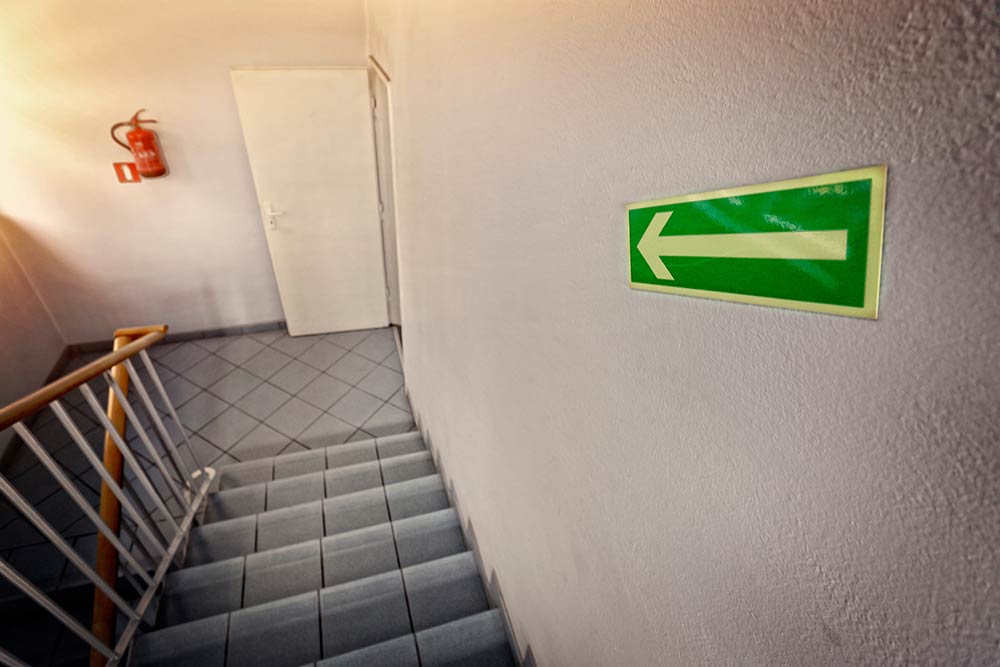
Escape route lighting, exit signs, and emergency lighting function as critical visual guides during an emergency, providing an added layer of safety for occupants who need to evacuate a building quickly and efficiently. Escape route lighting helps illuminate designated evacuation paths, while exit and emergency lighting assist occupants in identifying exits and navigating safely through the building during power failures, fire events, or other emergencies. These systems also help prevent accidents and injuries that may occur if individuals encounter darkened areas, obstacles, or reduced visibility while attempting to escape from a fire or hazardous situation.
If your building has a fire alarm system, then it’s likely that a portion of the building will have fire escape lighting. This lighting is used to illuminate the path to the exits in case of an emergency.
The exact requirements vary by jurisdiction but generally, all escape route lighting must be illuminated. However, in some cases, there may be exceptions to this rule. For example, if you’re located in a building with more than one exit and they are not all required by law to be lighted, then only one may need to be illuminated even though all are accessible from the same path.
No. The only requirement for an escape route lighting system is that it illuminate. This means that the light has to be on and working at all times, even when the building is empty or occupied.
The purpose of escape route lighting is to provide illumination during an emergency so that people can see their way around the building. It doesn’t matter if the lights are on or off, they just need to be on at all times.
Escape route lighting is often installed in large buildings like warehouses, hospitals and schools because they have multiple floors, corridors and staircases with no natural light sources available.
The purpose of escape route lighting is to illuminate the path to an exit in case of a fire. It’s not just there for show, but also to provide some light for the user because when you’re running away from a fire, it’s hard to see anything at all.
The illumination from the lights should be bright enough that someone can see their way through them and easily find their way out if they are lost.
If the facility is required to have emergency lighting then yes all means of egress illumination have to be illuminated. I do not know of anyway around this. The only exception would be if the emergency lighting system independent from the egress lighting system and it had a battery power source to illuminate emergency lights. Remember, if you said yes to any occupant utilising a wheelchair or walker for mobility assistance these individuals would be halted in their travels if emergency lighting is activated without illumination.